McNICHOLS CO.

Opening Size vs. Mesh Count: How to Choose the Right Wire Mesh for Performance-Critical Applications

Discover how crimp style can impact Wire Mesh strength, stability, and aesthetic appearance, and how to choose the right one for your project.

Choosing the Wire Mesh that Fits Your Application

When performance matters, selecting Wire Mesh is about more than picking a pattern that looks right. Several measurements work together to shape how Wire Mesh performs across a wide range of applications.

For McNICHOLS® Wire Mesh, understanding these measurements and their associated terms can help you compare products more confidently and choose the mesh that best supports your project goals.

Why Wire Mesh Measurements Matter

Wire Mesh is available in a wide range of patterns, materials, wire diameters, and opening sizes. Some products are rigid and structural, while others behave more like Wire Cloth, especially when the mesh count is high and the wires are fine. That difference can have a big impact on how the material looks, feels, and performs in use.

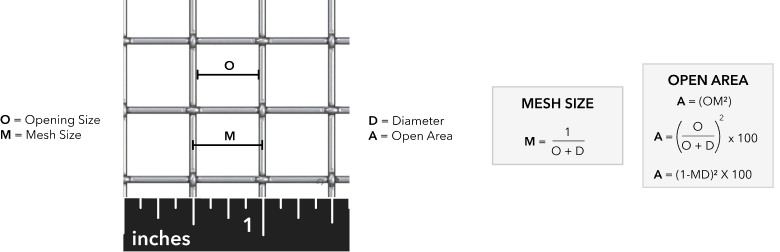
Before choosing a product, it helps to understand the four most common ways Wire Mesh is described and how these measurements affect product structure and performance. The diagram below illustrates how opening size, mesh size, wire diameter, and open area work together to define one another’s measurements and placement within a Wire Mesh pattern.

Diagram of Open Size and how it's measurements work
Lock Crimp Wire Mesh with a Mesh Count of 2 openings per linear inch

The Four Key Measurements

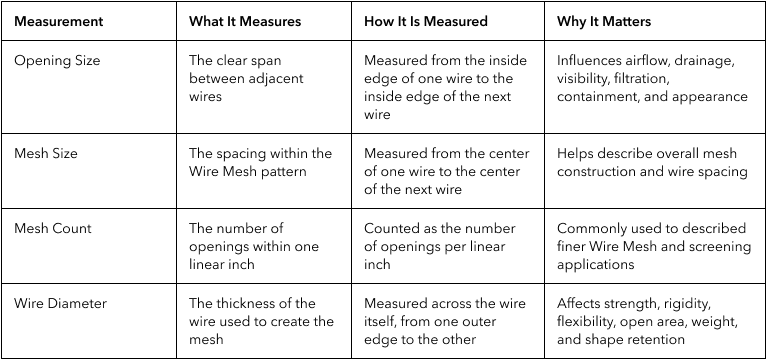
This table illustrates a quick overview of four key measurements used when determining your Wire Mesh selection. We encourage you to continue reading below for a more in-depth look into the nuances behind each measurement!

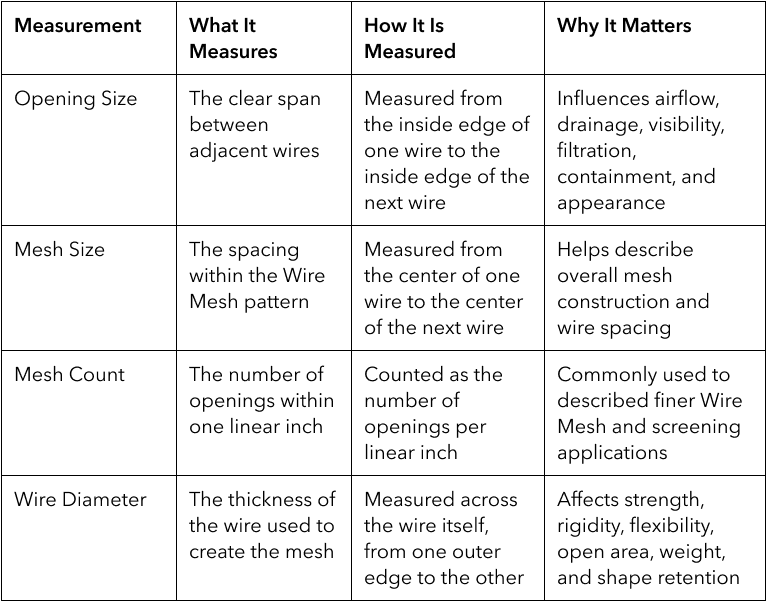
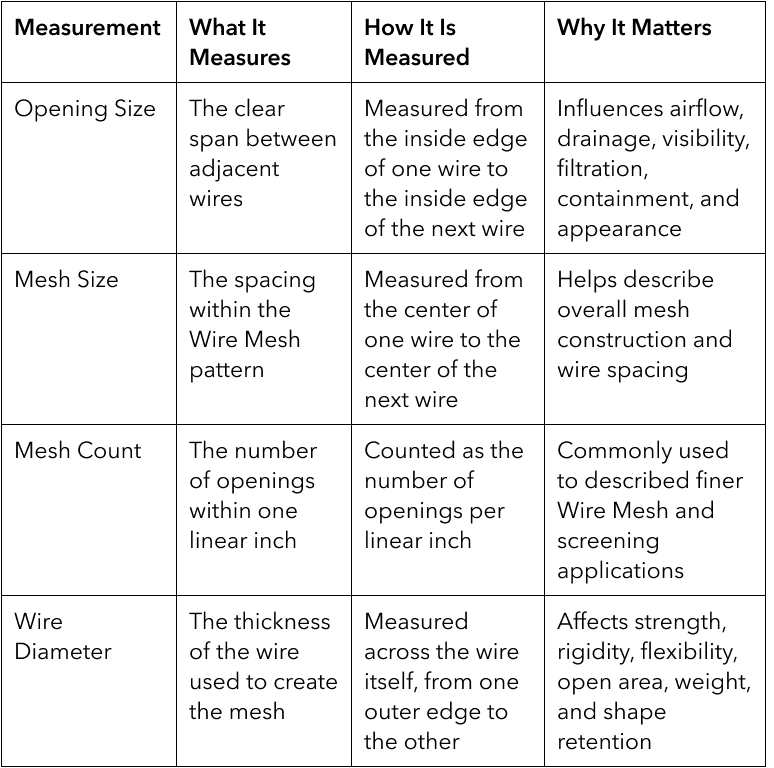
Table detailing the four key Wire Mesh measurements

Opening Size

The term “opening size” refers to the clear space between adjacent wires in a Wire Mesh sheet. It is measured from the inside edge of one wire to the inside edge of the next. For square openings, the measurement is typically shown as width by width, while rectangular openings are identified by both width and length dimensions.

Most McNICHOLS® Wire Mesh products list opening sizes in inches, with common examples including 1" x 1", 1/2" x 1/2", 1/4" x 1/4", and 1/16" x 1/16".

Opening size can influence performance, appearance, and overall functionality. Applications involving filtration, ventilation, drainage, visibility, light transmission, security, or containment often depend heavily on accurate opening size. This feature can also shape the final look of architectural applications, such as decorative Infill Panels.

In general, larger openings allow for greater airflow, visibility, and drainage, while smaller openings provide tighter screening, improved containment or filtration, and a more refined visual appearance. Understanding how opening size impacts your application can help you select a product that delivers both the performance and look you need.

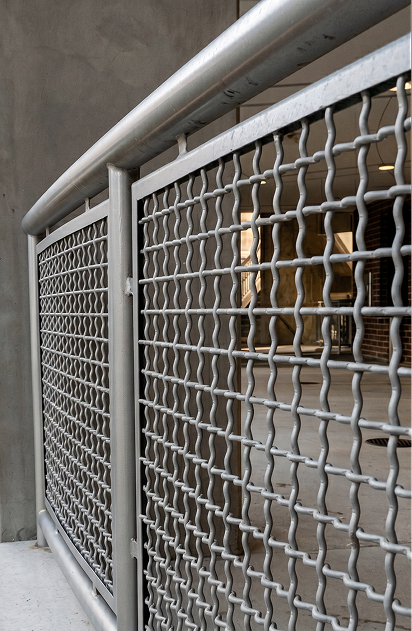
Intercrimp Wire Mesh fills in empty space on a railing
Intercrimp Wire Mesh Panel with a large wire diameter, large opening size, and low mesh count
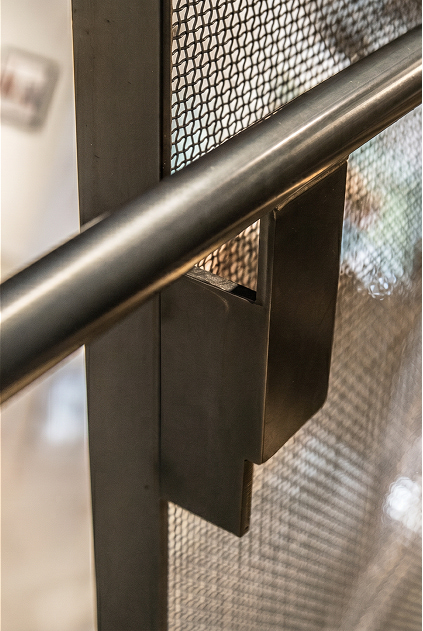
Designer Mesh with a small open area encloses the end of a stairway railing
Designer Wire Mesh Infill Panel with a small wire diameter, small opening size, and high mesh count.

Mesh Size

For McNICHOLS® Wire Mesh, mesh size refers to the spacing measured from the center of one wire to the center of the next. While opening size looks only at the clear space between wires, mesh size includes the wire itself as part of that spacing, giving you a more realistic image of how the mesh is constructed.

In cases of a wire with a thick diameter, the mesh size may be significantly different from the opening size. In contrast, for Wire Mesh where the wire diameter is thin, the mesh size may be comparable.

Mesh Count

Mesh count describes how many openings occur within one linear inch of Wire Mesh. In most cases, as the mesh count increases, the openings become smaller. This is why the mesh count is often the easiest and most practical way to describe very small openings.

For example, a mesh product with four openings per linear inch could just as easily be described in terms of a ¼" mesh size: each opening and its adjacent wire together measure ¼" of the whole inch. However, for a product with 100 openings per linear inch, it may be easiest to refer to the product as 100 Mesh (mesh count) rather than calculating a minute fractional metric for the mesh size.

As the mesh count gets higher, the material can start to feel more fabric-like. Fine, high-count mesh may resemble a screen or Wire Cloth more than a rigid structure. It may bend more easily, have some memory, and behave differently than heavier Wire Mesh made with larger openings and thicker wires.

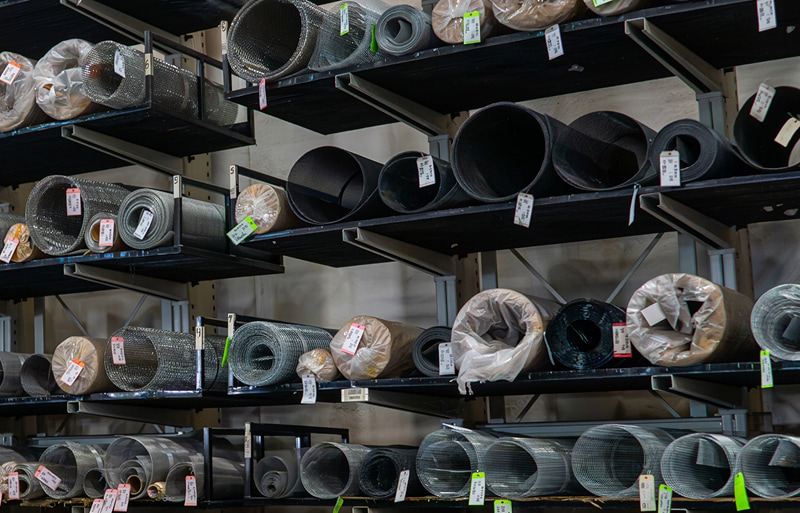
Wire Coil Inventory
McNICHOLS® Wire Mesh coils in a warehouse showcases vast inventory and the flexibility of Wire Mesh with high mesh counts and low mesh diameter

Wire Diameter

Wire diameter measures the thickness of the wire used to make the mesh. You may also see it referred to as "wire gauge." On McNICHOLS product pages, Wire Mesh is typically listed with either wire diameter or wire gauge, along with reference tools to help compare equivalent sizes.

This detail has a big impact on how a mesh product performs. Wire diameter can influence strength, rigidity, flexibility, open area, weight, appearance, shape retention, and even how the material responds under stress.

In general, a thicker wire creates a stronger, more rigid mesh that holds its shape well and stands up to more demanding applications. At the same time, that added thickness can reduce the opening size and the percent of open area. A thinner wire, on the other hand, creates a lighter, more flexible mesh and can increase open area, though it may not provide the same rigidity or shape retention as a heavier wire.

To really understand how a Wire Mesh product will look and perform, wire diameter is crucial. Two different Wire Mesh products may have the same opening size, but different wire diameters and, consequently, different rigidity, open area, and weight-bearing abilities.

Which Measurement Matters Most?

The short answer is simple: it depends on what the application needs most. A good rule of thumb is to match the measurement to the decision you are trying to make.

Filtration and Separation

In filtration, screening, and separation applications, opening size is often the first performance factor to consider. The opening must be small enough to retain or separate the target material while still allowing the desired flow of air, liquid, powder, or product. For fine filtration or precise separation, mesh count becomes especially helpful because the openings may be too small to describe conveniently in fractions of an inch.

Flow, Air, and Visibility

Open area is critical when the application requires drainage, visibility, or light passage. A larger open area can improve airflow and visibility. A smaller open area can provide more coverage, screening, or containment as well as greater security.

Strength and Shape Retention

Mesh counts with thicker wire diameters result in a more rigid product, while higher mesh counts with smaller wire diameters tend to be more flexible. That difference can be especially important in guards, enclosures, screening, and Infill Panel applications.

Appearance and Design

In architectural and decorative applications, opening size, mesh count, wire diameter, weave type, and finish all influence the final look. Larger openings can create a bold pattern and open appearance. Finer Wire Mesh can create a more refined or screen-like effect. For Infill Panels, partitions, facades, and railing inserts, it is important to balance appearance with code requirements, safety needs, and installation details.

Questions to Ask Before You Specify

When comparing Wire Mesh, ask these questions:

  1. What needs to pass through or be retained?
  2. Is a clear opening size or mesh count the more useful specification?
  3. Does the material need to be rigid or flexible?
  4. How important are airflow, drainage, light, or visibility?
  5. What material, finish, and fabrication requirements fit the environment?

These questions help narrow the selection from a general Wire Mesh category to a product that better fits the performance requirements of the application.

Conclusion

Selecting the best Wire Mesh is about understanding how opening size, mesh count, mesh size, and wire diameter all work together to support your application's goals. By evaluating these characteristics together, you can confidently choose a product that delivers the desired balance of functionality, appearance, and long-term performance!

McNICHOLS is the leading supplier of Specialty Metal and Gratings in the U.S. and has 19 locations nationwide. We are ready and Inspired to Serve® you at 855.318.8791, [email protected], or via Live Chat on mcnichols.com.