When specifying drainage systems, understanding the unique benefits of Trench Drains can help when determining whether to choose a Grating cover or McNICHOLS POLYCAST® Presloped Trench Drain System for your water management. This guide covers the basics, like how Trench Drains work, the components of your McNICHOLS® Trench Drain Kit, installation considerations, and common applications so you can confidently plan the right water management solution for your project!
Selecting the proper Trench Drain system involves assessing things like hydraulic capacity and load requirements as well as flow rate and system configurations. That's why we've created this helpful guide to help you learn how to create an effective drainage solution!
A Trench Drain manages the high flow rate required for a municipal street.
Heavy-duty frame provides adequate drainage for this airport runway.
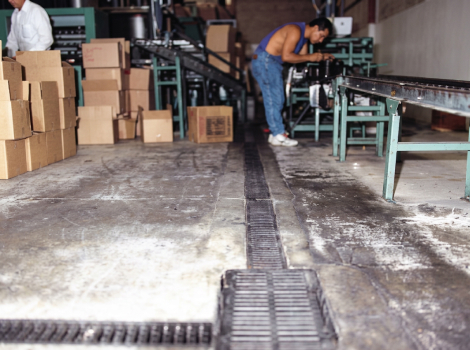
This distillery floor has been retrofitted with a Presloped Trench Drain.
What is a Trench Drain?
A Trench Drain starts with a linear channel installed below grade and covered by a slotted grate. Water enters through the openings and flows along the channel incline toward designated outlet locations, where it is then discharged into a stormwater system.
Unlike traditional point drains that collect water at a single location, Trench Drains collect runoff along the entire length of the channel, making them ideal for areas with high water volume or long drainage paths. They are designed to quickly capture and redirect water before it can be collected on surfaces. The even, linear path of a Trench Drain channel can contribute to faster and more consistent flow rates across longer runs than traditional drains.
Additionally, the built-in slopes of Trench Drain channels reduce the need to create a continuous slope in the surrounding concrete surface. This can help simplify installation and support more level surface designs.
Understanding how a Trench Drain functions can help you evaluate key specifications and project requirements. In most systems, performance depends on three core steps:
Water Collection: Surface water enters the Trench Drain through openings in the grate. Consideration: Grate open-area influences both hydraulic efficiency and safety requirements, making grate selection an important part of the overall system design.
Conveyance: Once water enters the system, it travels through the channel toward designated outlet locations. Consideration: Channel width, depth, slope, and overall system layout all contribute to drainage performance.
Discharge: Water exits the Trench Drain through outlets into larger wastewater infrastructure. Consideration: Proper channel sizing and outlet placement help maintain high flow rates and reduce the risk of standing water.
Main Components of a Trench Drain System
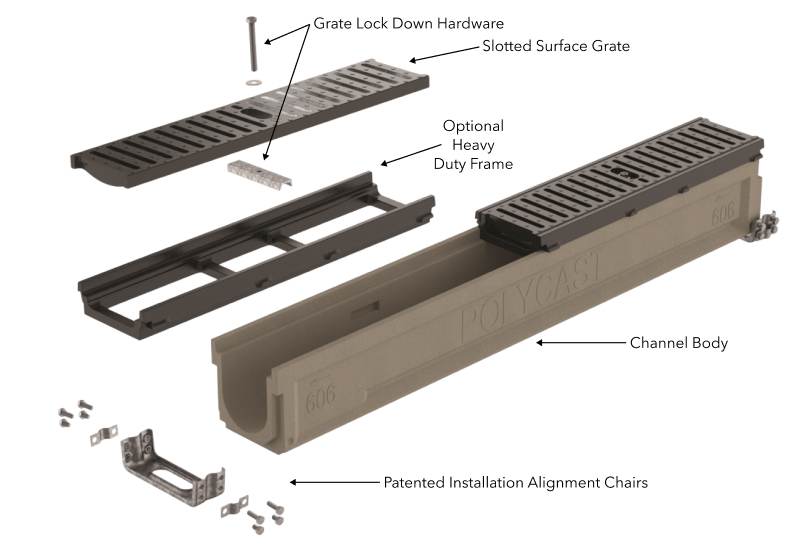
Understanding the individual components that come with your McNICHOLS POLYCAST® Presloped Trench Drain System makes it easier to specify the right configuration for your application.
Every McNICHOLS® Trench Drain Kit includes 48" channel bodies, 24" slotted surface grates, installation alignment chairs, inlet and outlet end caps, and grate lockdown accessories. If your project requires additional channel installation alignment chairs, please let us know, and we would be happy to provide them!
Channel: The channel forms the body of the drainage system and directs water toward the outlet.
Surface Grate: The grate creates a load-bearing surface while allowing water to enter the channel below.
Grate Lock Down Hardware: Accessories designed to bolt your surface grate securely to the channel body.
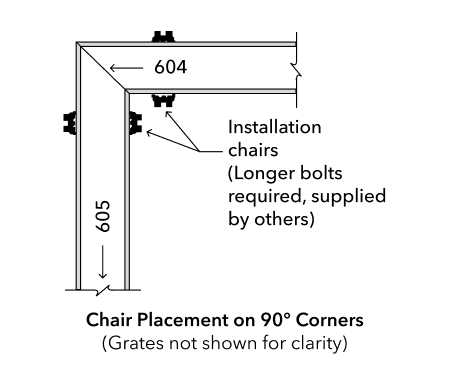
Installation Alignment Chairs: Alignment chairs help align channels and set elevation while also securing structural joint sections.
Specifying a Trench Drain System
Primary Material
Constructed from polymer concrete, POLYCAST® Presloped Trench Drain Systems are strong and chemical-resistant. Their low-absorption material composition helps support proper water transfer with minimal runoff. The polymer construction is four times stronger than ordinary cement concrete, and surface grates are made from cast iron for maximum durability.
Flow Rate
POLYCAST® Presloped Trench Drain Systems are designed to have flow rates equal to, or in some cases, even greater than, larger poured-in-place Trench Drains. With the proper specifications, a flow rate of 840 GPM per outlet is attainable. We encourage you to consult project engineers for your desired flow rate when determining your Trench Drain solution.
Load-Bearing Capacity
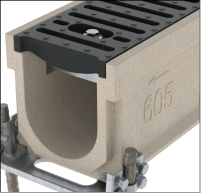
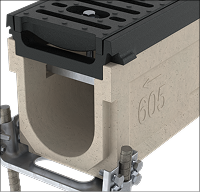
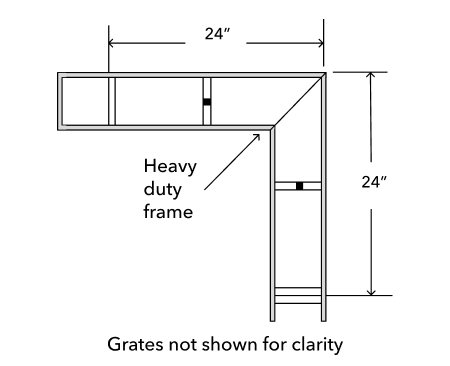
Our Series 600 Presloped Drain Systems are designed to withstand standard tire traffic in addition to pedestrian loads. For applications requiring additional load-bearing capacity, we offer an optional Heavy-Duty Hardnose Frame on request.
Light to Moderate
Heavy-Duty
Kit Length
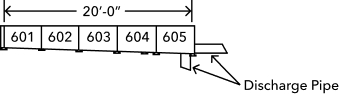
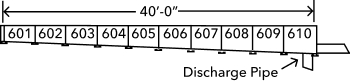
We are pleased to offer two ready-to-install kits from stock inventory: A 20-linear foot (Kit 1) and 40-linear foot (Kit 2). Channel lengths may also be cut-to-size or combined to accommodate alternative layouts or job-site specifications.
20' Run Application
40' Run Application
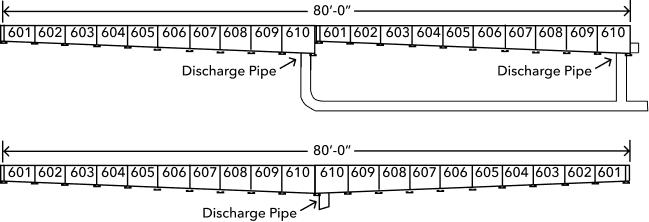
Job Site Customizing
Installing Your Trench Drain
While installation requirements vary by project, most Trench Drain systems follow the same general process:
Prepare the excavation.
Position and align the channels using our patented installation alignment chairs. Proper alignment is essential for maintaining consistent water flow and creating a level finished surface.
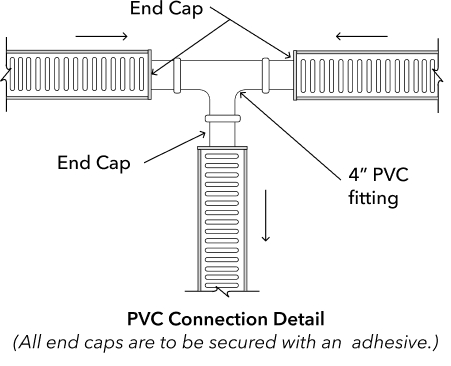
Connect outlet piping to complete the channel, then pour the surrounding concrete.
Bolt down and secure the grating covers with accessories.
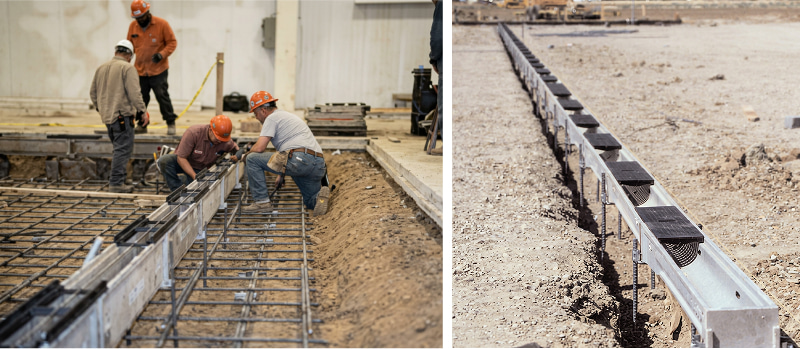
Photos show the installation process of the Presloped Trench Drain Systems.
Designing a Trench Drain Layout
Every project has unique drainage requirements. Whether it's overall run length, number and location of outlets, traffic requirements, surface slope, or channel depth, McNICHOLS POLYCAST® Presloped Trench Drain Systems can be customized to a wide range of needs.
Corner and Connection Options
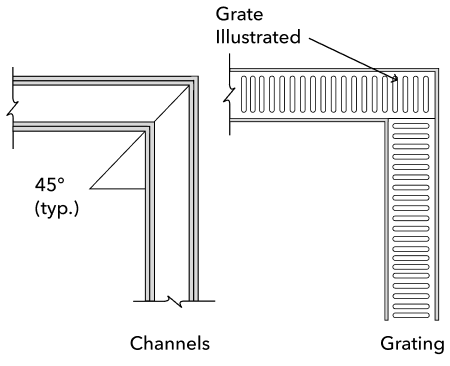
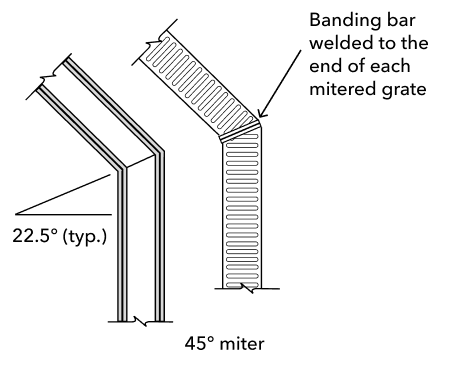
Trench Drain systems can be configured to navigate corners and connect to existing drainage infrastructure. Mitered corners, end caps, and PVC outlet connections help create flexible layouts while maintaining drainage performance. If you are in need of guidance on retrofitting your Trench Drain System to your project, any of our knowledgeable Customer Service Specialists are happy to help!
More installation details:
Why Choose McNICHOLS for Trench Drain Solutions?
With a vast inventory and 19 locations nationwide, McNICHOLS helps customers identify Trench Drain and Grating solutions that meet drainage requirements quickly and efficiently. From product selection and specification assistance to Value-Added Services and technical support, the Hole Team is committed to delivering superior Service, Quality, and Performance on every project.
We invite you to contact us at 813.466.6979, [email protected], or via Live Chat on mcnichols.com to discover why customers nationwide rely on us as their trusted project partner for Trench Drain solutions.