SKU Type
Each of McNICHOLS Quality products has an SKU type that identifies the form in which the material is stocked. Typical SKU types are sheet, plank, panel, coil, piece and each.
SWD
(Short Way of Diamond) Distance from an outside point on a bond to a corresponding outside point on the following bond across the short distance of the diamond opening. Sometimes called pitch. Also the distance across all of the short openings of all of the diamonds in the sheet.
SWO
(Short Way of Opening) Distance across the short opening of the diamond from a point on the inside of the bond to a corresponding inside point of the next bond.
Saddle Style
This identifies the style of the mounting to which the pipe or tube is attached on a handrail bracket.
Sand Blasting
Sand Blasting is a mechanical finishing. There are several types of Sand Blasting. Basically, the surface is subjected to a stream of high velocity sand under air or steam pressure. The sand removes scale or encrusted material and creates a dark gray brushed appearance. Sand Blasting may be a good choice when there is a desire to improve the appearance of a standard mill finish. If you want a product sandblasted, specify this in the comments box during the request for quote process.
Sealing Kits
Material that can be mixed and applied to the cut surfaces of fiberglass products to reseal and protect them.
Selvage (wire cloth)
The edge or border of wire cloth, finished to prevent unravelling (versus a raw or cut edge). Types of selvage edges include looped, folded, welded and fine mesh border pattern. Selvaged edges are not available on cut-to-size pieces.
Series
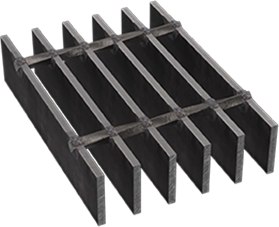
Most McNICHOLS grating types (bar or safety gratings, for example) are grouped into series (GAL, GCM-1, etc) based on bearing bar and cross bar spacing and bearing bar size.
Shearing
Cutting expanded metal to size to produce various sizes and shapes.
Sheet and Plate
A flat sheet or plate, but not a flooring product (see Molded/Pultruded Plate Flooring for that).
Shute Wire (wire cloth)
(wire cloth) - The wires in wire cloth that run parallel to the width (i.e., the short side of the roll or sheet) - see line wire.
Sieve
Wire Mesh products constructed by attaching a specific opening or mesh size to a round frame. These products are used in testing applications to size material.
Slip-on Fittings
Lightweight cast Aluminum components that attach to pipe mechanically via a hex screw to make railing sections. These are available as either "in line" or offset design.
Slot Length
Some perforated metal is punched with slotted holes. The slot is described as having a width dimension in inches and a length dimension in inches. The width is the short way of the slot, the length is the long way of the slot.

Slot Width
Some perforated metal is punched with slotted holes. The slot is described as having a width dimension in inches and a length dimension in inches. The width is the short way of the slot, the length is the long way of the slot.

Space Cloth (Wire Cloth)
Wire cloth designated by the aperture (open space) width, expressed in inches or fractions thereof. Space cloth specifications are typically used for mineral, ore, sand and gravel screening.
Spacing Description
This characteristic identifies common spacing descriptions for Bar Grating and Pultruded Fiberglass Grating. These values serve as a quick reference to the bearing bar spacing, the cross bar spacing and the method of construction for an item.
Span (bar grating)
Span is the length of the grating across two consecutive bar grating supports. Span includes both the supported and unsupported sections of the grating. (see clear span)
Splice Plates
Products used to connect two separate pieces of plank grating together to form a single piece.
Square Hole
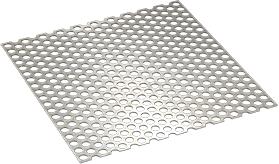
Perforated material punched with square holes.
Square Mesh
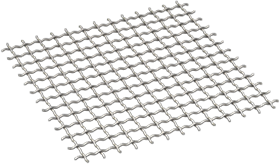
Welded or Woven Wire Mesh in a square pattern defined by the number of openings per inch(mesh).
Square Opening
Welded or Woven Wire Mesh in a square pattern defined by the opening size.
Squareness
Products are square within manufacturing tolerances. Should squareness be critical, sheets can be square sheared.
Stair Tread Covers
Non load bearing products used to cover existing load bearing stair treads to provide a renewed or different walking surface.
Stair Tread Type
Bar Grating Stair Treads are described in three types. Type A-Standard is an aluminum stair tread finished with Corrugated Angle Nosing. Type B-Standard is a welded or press-locked stair tread finished with Checkered Plate Nosing. Type C-Special is available in either steel or aluminum and is finished with a Cast Abrasive Nosing.
Stair Treads
Products used specifically as load bearing treads on stairs, either with or without integral end plates.
Standard
Expanded metal products that are left in their primary expanded state (not flattened).
Standard Expanded Metal
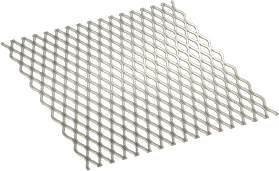
Also called regular, unflattened, or raised expanded metal. Expanded metal as it comes from the press. The strands and bonds are set at a uniform angle to the plane of the sheet.
Straight Rows Parallel To
Perforated metal is often made by punching a series of straight rows, each offset or "Staggered" from the next. The way the pattern fits on the sheet is described by the direction of the straight rows as being parallel either the "width" or "length".
Strand (expanded metal)
The single metal strip that forms the border of the diamond, or opening in the expanded metal.
Strand Thickness
Expanded Metal appears as a diamond shaped pattern with the strands being the metal that forms the pattern. Each strand has a width and a thickness. This characteristic identifies the thickness of the strand in a given Expanded Metal pattern.
Strand Width
Amount of material fed into the press to produce one strand.
Striation
Grooves or channels cut or extruded in the surface of grating, usually parallel to the length, for the purpose of providing slip resistance.
Structural Quality
Material applicable to the various classes of structures, indicated by the standard specifications, which is suitable for the different mechanical operations employed for the fabrication of such structures. Structural quality (the characteristics of which are defined by the American Society for Testing Materials) represents the quality of steel produced under regular or normal manufacturing conditions.
Structural Shapes
These products are used to provide a supporting structure such as I-Beams or of a unique shape such as tube, rod or channel.
Stubs (bar grating)
The bearing bar lengths along the cut edge of a piece of bar grating measured from the end to the nearest cross bar.
Studs
An item that is welded to a piece of angle to create a fabricated product called embedment angle. Embedment angle is set into concrete to form the shelf for a trench on which grating rests; the studs serve to lock the angle into the concrete.
Studs and Nuts
Pultruded vinylester rods with optional partial length threading to accept thermoplastic hex nuts.
Surface Finish
The description, name or numbering convention that describes the finish of a material's surface.
Surface Pattern
This characteristic is used on McNichols products when an item may be specified with different surface patterns and serves to identify the pattern required.
|